
Reich Gottes oder Realpolitik? Warum Utopien in Terror enden können
14. Oktober 2026
Mkwawas Schädel: Ein Vertragsartikel, ein falscher Schädel, ein echter Zahn
16. Oktober 2026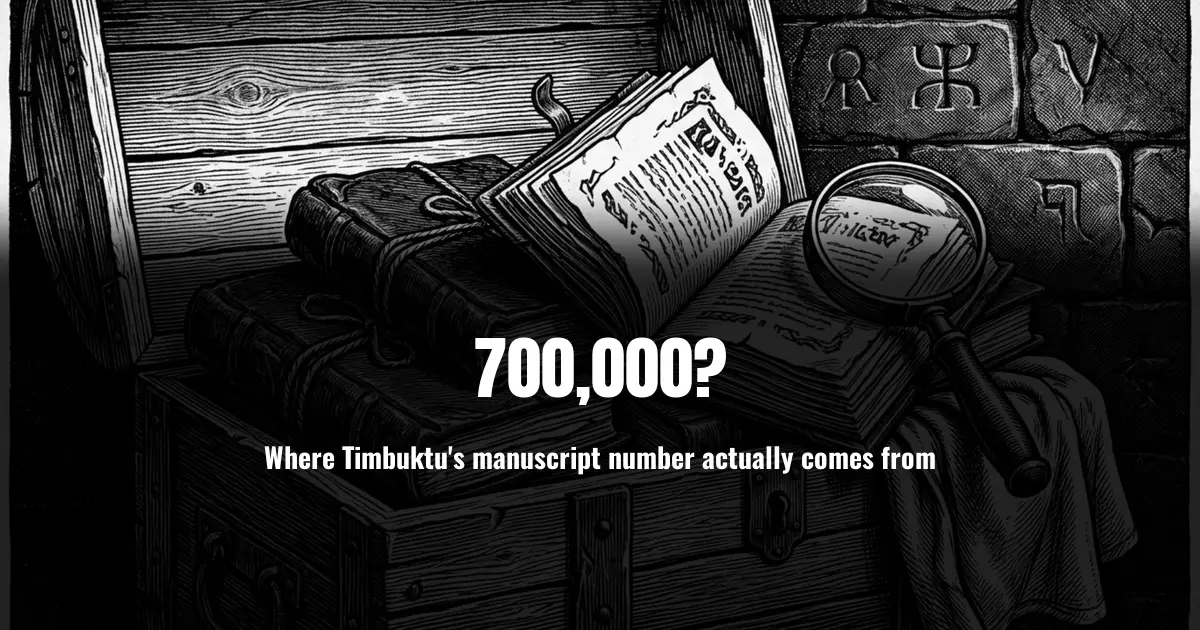
# Timbuktu’s Manuscripts: Where Does 700,000 Actually Come From?
Search for how many manuscripts survive in Timbuktu and the same sentence appears on dozens of sites, worded almost identically: „National Geographic estimates that 700,000 manuscripts have survived in Timbuktu alone.“ It is on a UK schools resource, an Islamic law blog, a legal-services blog in Colorado, an African heritage brand’s news page, and a language forum, most of them citing each other rather than the magazine. One copy of the sentence, reproducing a chain of earlier copies, states that 700,000 manuscripts survive in Ethiopia. Nobody caught the error, because nobody was checking against the source. There is no indication anyone who repeated the figure went and read a National Geographic article to find it.
So the first useful question about Timbuktu’s manuscripts is not how many there are. It is where the number everyone cites actually came from.
What the blogs cite, and what it traces to
The 700,000 figure, in every version found, traces back to a single 2011 case study published by the UK’s Understanding Slavery Initiative, „The Lost Libraries of Timbuktu.“ That page attributes the number to National Geographic without a link, a date, or an author. From there it was copied, in close to identical wording, onto an Islamic-law blog in 2020, a heritage-brand news page, a genealogy and travel blog, and others, each restating „National Geographic estimates“ without independently checking National Geographic.
No article on National Geographic’s own site states 700,000 for Timbuktu. Its January 2011 magazine feature, „The Telltale Scribes of Timbuktu,“ gives no city-wide total at all, only that many thousands of manuscripts are thought to lie buried in the desert or hidden away. Its 2016 piece on Abdel Kader Haidara’s rescue operation states that his personal collection, the largest in the city, held 377,000 manuscripts by the time of the 2012 jihadist occupation, and that the emergency evacuation moved an estimated 350,000 manuscripts out of 45 libraries to Bamako. Its 2021 history-magazine piece states plainly that nobody knows how many manuscripts existed in the city’s golden age, only that the number almost certainly ran into the hundreds of thousands. None of these three pieces, the only substantial National Geographic reporting on the subject found in this research, gives a figure of 700,000 for the city.
Where 300,000, and the actual counted totals, come from
Set beside the untraceable 700,000, three figures do trace to something concrete.
The Ahmed Baba Institute, the public research institution founded in Timbuktu in 1970, holds roughly 30,000 manuscripts, a number that recurs consistently across sources including Hunwick and Boye’s 2008 book The Hidden Treasures of Timbuktu, the standard scholarly account of the city’s literary heritage. That is a public collection, cataloguable and, since the 2012 crisis, substantially digitised.
Haidara’s own family collection, held privately and later formalised as the SAVAMA-DCI foundation, reached 377,000 manuscripts by 2012, according to National Geographic’s own reporting on his rescue effort. That is the largest single private holding, not the total for the city, and it belongs to one family among the roughly sixty private and institutional libraries that Hunwick and Boye counted in Timbuktu at the time of their book.
The 350,000 figure that recurs in current tourism and heritage writing describes something different again: the number of manuscripts smuggled out of Timbuktu to Bamako during the nine-month jihadist occupation of 2012 and 2013, drawn from those 45 libraries together, not a count of everything that existed in the city.
None of these three, 30,000 public, 377,000 in one family’s collection, 350,000 evacuated across 45 libraries, sums cleanly to either 300,000 or 700,000. They describe different subsets, counted at different times, by different people, for different purposes.
What Hunwick and Boye actually wrote
The one figure that does approach a million did not originate as a Timbuktu number at all. Hunwick and Boye’s book states that a million manuscripts may have survived, in their words, dispersed throughout the region, from the shores of the Mediterranean to the northern fringes of the forest regions of Guinea and Ghana. I quote the phrase because it is the whole of the claim and the whole of the problem: that is a figure for the entire Saharan and Sahelian manuscript tradition, stretching across what is now Mauritania, Mali, Niger, northern Nigeria and beyond, not a count of Timbuktu’s libraries alone. Somewhere in the copying chain, a regional estimate for a manuscript culture spanning half a continent became a city-specific figure, attached to a citation nobody can locate, and then rounded down to 700,000 for a single town.
What doesn’t add up
**A number with a named source that does not say it.** Every instance of „National Geographic estimates 700,000“ traces back through a chain of blogs to one 2011 case study that cites the figure without a link, an article title, or a page number. Three substantial National Geographic articles on this exact subject, spanning 2011 to 2021, give no such figure, and one gives an explicit caveat that the true number is unknown. A citation that cannot be pointed to a specific sentence in a specific publication is not a source. It is a placeholder that has been treated as one for over a decade. What would settle it: if the figure exists in an older National Geographic piece not covered by this search, a caption or a print-only article predating the magazine’s online archive, whoever first wrote the citation should be able to name it. So far, nobody who repeats it has.
**A regional estimate wearing a city’s name.** Hunwick and Boye’s actual million-manuscript figure describes a tradition spread across the whole Sahara-Sahel corridor. Reduced to „700,000 in Timbuktu alone,“ it implies a density of survival, one town holding most of an entire region’s written heritage, that the counted subsets do not support: 30,000 public, 377,000 in the largest private collection, 60 libraries in total. What would settle it: a library-by-library census of Timbuktu’s roughly sixty family and institutional collections, comparable to what Hunwick and Boye began and SAVAMA-DCI has continued since the 2012 evacuation, published as a running total rather than left to be estimated once and copied for fifteen years.
What stays open
Nobody disputes that Timbuktu held an extraordinary concentration of manuscripts, in the hundreds of thousands by any careful count, or that the city’s scholars were producing original work in law, astronomy and Sufism centuries before European contact. What is not known is a defensible total, because the sixty-odd private libraries have never all been counted at once, families have historically kept them hidden for good reason, dating to the manuscript burnings of the French colonial period, and the one number circulating with the most authority attached to it, 700,000 from National Geographic, appears to be attached to nothing at all.

KardiKassin
Writes about Africa’s history and how it gets told, sourced and checked at every step.
Made in Germany: How Your Picture of Africa Was Manufactured
A number with a named source that never actually said it, copied for over a decade. The free 12-page ebook traces that exact kind of manufactured fact across a whole continent’s worth of image-making.
Sources
- Hunwick, John O. and Alida Jay Boye: The Hidden Treasures of Timbuktu: Rediscovering Africa’s Literary Culture. London: Thames and Hudson, 2008
- Understanding Slavery Initiative: The Lost Libraries of Timbuktu. https://understandingslavery.com/casestudy/the-lost-libraries-of-timbuktu/
- Islamic Law Blog: „700,000 Ancient African Books Have Survived In Mali’s Timbuktu University,“ 3 February 2020. https://islamiclaw.blog/2020/02/03/700000-ancient-african-books-have-survived-in-malis-timbuktu-university/
- National Geographic: „‚Badass Librarians‘ Foil al Qaeda, Save Ancient Manuscripts,“ 2016 (the 377,000 and 350,000 figures); and „Why Timbuktu’s True Treasure Is Its Libraries,“ 2021/2022. https://www.nationalgeographic.com/history/article/badass-librarians-joshua-hammer-timbuktu-manuscript-al-qaeda