
Albrecht von Brandenburg-Ansbach: Der letzte Hochmeister
21. September 2026
Schwarz und Black: Der Großbuchstabe, der beim Übersetzen verschwindet
23. September 2026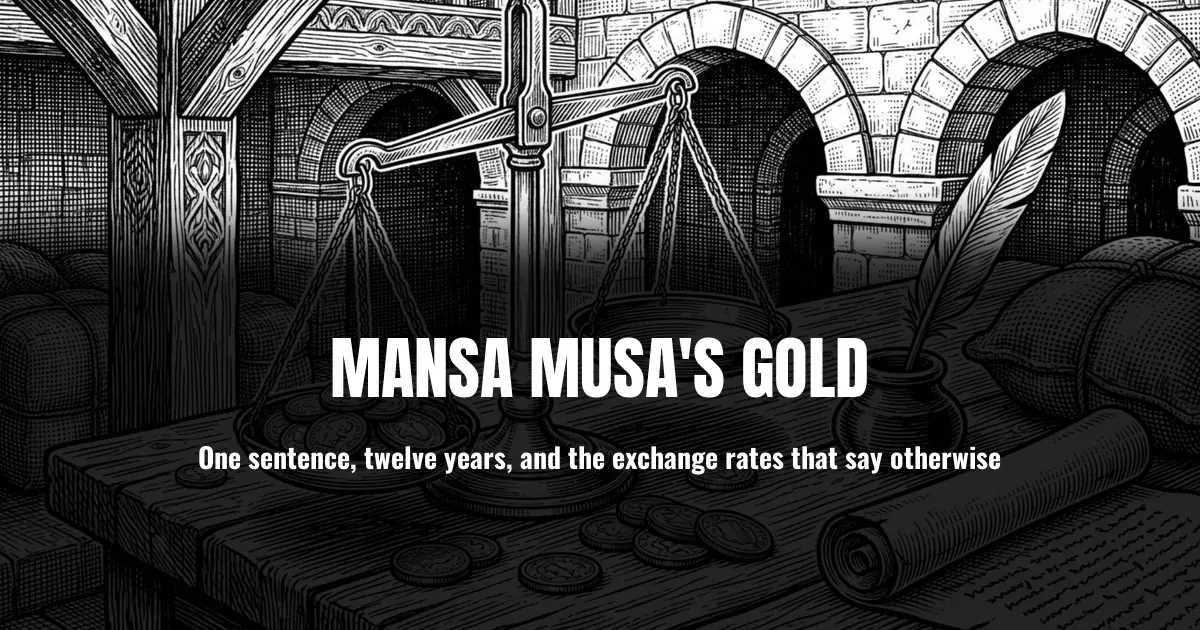
# Mansa Musa’s Gold in Cairo: One Sentence, Twelve Years, and the Exchange Rates That Say Otherwise
Open almost any world history textbook to the chapter on Mali and the same event appears: in 1324 Mansa Musa passed through Cairo on his way to Mecca, handed out so much gold that its price collapsed, and Egypt’s economy took a decade or more to recover. Some books say twelve years. Some say a generation. One says the damage was ruinous.
Every one of those sentences traces back to a single paragraph by a single author who was not in Cairo when it happened. That is the finding of Warren Schultz, a historian of Mamluk money at DePaul University, in a 2006 essay that few outside Mamluk studies seem to have read. What follows is what his paper found, and what it leaves open.
The paragraph the story rests on
The author is Shihab al-Din Ahmad ibn Fadl Allah al-Umari, who died in 1349. He came from a family of chancery scribes and worked at times in the highest ranks of the sultan’s secretariat in Cairo. He was not an eyewitness to the pilgrimage; in 1324 he was in his native Syria. What he wrote, in his encyclopaedic Masalik al-absar, was what he heard afterwards from people who had been there, above all the emir Abu al-Abbas Ahmad ibn al-Hakk, the mihmandar, the official who received foreign dignitaries. The passage is translated in Levtzion and Hopkins, Corpus of Early Arabic Sources for West African History (1981), pages 269 to 271, and an excerpt is freely available at World History Commons.
Al-Umari makes two claims, and it pays to keep them apart. The first: the Malians spent and gave away so much gold that its value against silver fell. The second: that fall lasted. Before Musa arrived, a gold mithqal fetched at least 25 silver dirhams, usually more. Afterwards it fetched 22 or fewer. And then the sentence that built the textbook version: „This has been the state of affairs for about twelve years.“ I quote it because the whole argument turns on it. Twelve years is not a rhetorical flourish; it is a duration, and a duration can be checked.
That sentence also dates the writing. If Musa came in 1324 and al-Umari was writing „about twelve years“ later, the passage belongs to the late 1330s, when al-Nasir Muhammad was still sultan and al-Umari had already been dismissed and imprisoned by him at least once. Schultz raises the possibility that a claim of lasting economic harm under this ruler was a veiled criticism of the ruler, and then, to his credit, labels it speculation. It stays labelled that way here.
Who else says it
Mamluk-era authors mentioned Musa’s visit often. Schultz lists nine besides al-Umari: Ibn al-Dawadari, Ibn Battuta, Ibn Kathir, Ibn Khaldun, al-Maqrizi, Ibn Hajar al-Asqalani, al-Dhahabi, Ibn Habib, Ibn Duqmaq. Of these nine, three mention a drop in the gold-to-silver rate at all. Ibn Kathir says a gold coin lost two dirhams. Al-Maqrizi, in two separate works, says six. Ibn Hajar says it fell and gives no figure. None of the three states an initial rate, so the numbers cannot be reconciled, but together they do support al-Umari’s first claim. Something happened to the price of gold in Cairo in 1324.
Not one of the nine supports the second claim. Nobody but al-Umari says the effect lasted twelve years, or years at all. Schultz adds that he found no other Mamluk author, in or out of that list, who links a long-term fall in gold to the pilgrimage.
So the sensational half of the anecdote, the half that made it into textbooks, has one witness. He was a well-placed adult living in Cairo shortly after the events, which counts for something. He was also an official with a grudge, which counts the other way.
Fifty years of exchange rates
Schultz’s real contribution is not the source count but the table. He collected every gold-to-silver exchange rate he could find for Cairo between 1299 and 1349, roughly a quarter century either side of the pilgrimage, from chronicles, from documents cited in Rabie’s study of Mamluk finance, and from five marriage and business papers out of the Cairo Geniza published by Goitein in 1965.
The picture is not what al-Umari describes. The rate to which the market keeps returning is 20 dirhams to the mithqal, not 25. It is cited nineteen times on its own and six more times as the rate before or after a swing. Rates above 20, mostly 25, appear nine times. Rates below, down to 11, appear four times. For the twenty years from 1299 to 1318, 20:1 is the only rate recorded. For 1325, the year after Musa left, a source reports a return to 20:1. For 1332 to 1338, five citations, all 20:1 again.
The Geniza papers look at first like an outlier, at thirteen and a third silver to one gold, until the arithmetic is done. Those documents reckon in pure silver. Mamluk dirhams of the period were about two-thirds silver by modern assay, and roughly three grams each. Forty grams of silver per gold coin comes out either way. The Geniza rate is 20:1 in circulating coin, and it holds across the whole half century, before the pilgrimage and after.
The one stretch of real turbulence is 1338 to 1342, when the rate swings between 25:1 and 20:1 at least five times. That is fourteen years after Musa. Schultz links it, tentatively, to the notorious financial administration of the sultan’s adviser al-Nashw, and it is also, not by coincidence, the period in which al-Umari was probably writing.
Two things stand out. The 25:1 that al-Umari treats as the normal pre-Musa rate is in fact the rare high end of the range. And the drop he describes, from 25 to 22 or so, lands squarely on the rate the sources call ordinary. On the numbers, Musa’s gold did not crash the market. It pushed a temporarily high rate back toward its long-run level.
Other shocks did the same. In 1325, a source records amirs selling off ornamental gold in quantity, with an effect on the rate. In 1342, the sacking of the amir Qawsun’s palace released a large amount of gold into circulation and the rate dropped sharply. Schultz places the Malian gold in that company: one of several supply shocks in a market where gold and silver were two commodities priced against each other, not a managed currency.
How one paragraph became every textbook
The transmission chain is short and worth spelling out. Gaudefroy-Demombynes translated the relevant sections of al-Umari into French in 1927. Basil Davidson put passages from that French into English in The African Past in 1964. E. Jefferson Murphy’s History of African Civilization (1982) used Davidson, and is cited by name in two of the textbooks Schultz surveyed. A second, independent line runs through the 1981 Levtzion and Hopkins translation. Of the fifteen American world history textbooks Schultz examined, fourteen mention the pilgrimage, twelve describe an economic disruption, and eight say it was long-term. Only three cite any source at all.
The duration grew in transit. Al-Umari says about twelve years. Textbooks say „years,“ „over a decade,“ „a generation.“ One says „ruinous Egyptian inflation for a generation,“ which is a stronger claim than any medieval author makes.
What doesn’t add up
**The chain of citation has one link at the top, and that link is hearsay.** Trace the textbook sentence back and it runs through Murphy, Davidson and a 1927 French translation to al-Umari, and al-Umari’s own source is a conversation with the mihmandar, held years after the fact and reported in a sultan’s secretary’s encyclopaedia. Nine other Mamluk authors who wrote about the same visit did not repeat the twelve-year claim, including al-Maqrizi, the one most interested in prices. That does not prove al-Umari wrong; a single well-placed witness can be right when the chorus is silent. It does mean the most quoted economic fact about medieval West Africa has never had a second source. What would settle it: an independent price series from the 1320s and 1330s, for example dated grain or cloth prices in Cairo showing a sustained shift, or a second contemporary reference to the twelve years that is not derived from the Masalik.
**The baseline and the record cannot both be right.** Al-Umari’s story needs 25:1 to be normal, so that 22:1 counts as a collapse. The fifty-year table says 20:1 is normal and 25:1 the exception. If the table is right, his „cheap“ gold was gold at its usual price. Schultz’s table is thin, and he says so: many years have one rate or none, some rates are declared rather than observed, two entries look like scribal errors, and the whole thing leans on al-Maqrizi, a fifteenth-century compiler. A fuller run of dated Geniza and chancery documents for 1318 to 1332, the six years before the pilgrimage and the eight after, would show whether 25:1 really held in the early 1320s or whether al-Umari was reasoning back from the rate of his own troubled decade.
What stays open
Musa’s gold did move the market in 1324. On that, four Mamluk authors and the physics of a bullion economy agree. How far, nobody knows, because no author states both the before and the after rate. How long, only one author says, and the exchange-rate record does not back him.
The rest is unchanged. The size of the caravan, the loads of gold, the refusal to kneel before the sultan, the reputation that reached a Catalan mapmaker in 1375: those come from the same sources and stand or fall on their own. What this changes is smaller and more specific. A number that has been printed as fact for a century turns out to be one man’s estimate, made in a bad decade, about a good one.

KardiKassin
Writes about Africa’s history and how it gets told, sourced and checked at every step.

Made in Germany: How Your Picture of Africa Was Manufactured
One writer’s guess, repeated for a century, became the textbook fact about Mali’s gold. The free 12-page ebook traces that same kind of drift across a whole continent’s worth of image-making.
Sources
- Schultz, Warren C.: Mansa Musa’s Gold in Mamluk Cairo: A Reappraisal of a World Civilizations Anecdote. In: Judith Pfeiffer and Sholeh A. Quinn (eds.), History and Historiography of Post-Mongol Central Asia and the Middle East. Studies in Honor of John E. Woods. Wiesbaden: Harrassowitz, 2006. https://www.academia.edu/81562385/
- Levtzion, Nehemia and J. F. P. Hopkins (eds.): Corpus of Early Arabic Sources for West African History. Cambridge University Press, 1981 (repr. Markus Wiener, 2000), al-Umari pp. 269 to 271
- World History Commons: Al-Umari’s Account of Mansa Musa’s Visit to Cairo (excerpt from Levtzion/Hopkins). https://worldhistorycommons.org/al-umaris-account-mansa-musas-visit-cairo
- Goitein, S. D.: The Exchange-rate of Gold and Silver Money in Fatimid and Ayyubid Times. Journal of the Economic and Social History of the Orient 8, 1965 (Geniza documents, cited via Schultz)