Keine Privilegierung der Kirchen: Ein Versprechen, das älter ist als die Partei, die es gerade macht
28. September 2026
Politischer Moralismus: Ein Buch von 1987, das klingt wie aus dieser Woche
30. September 2026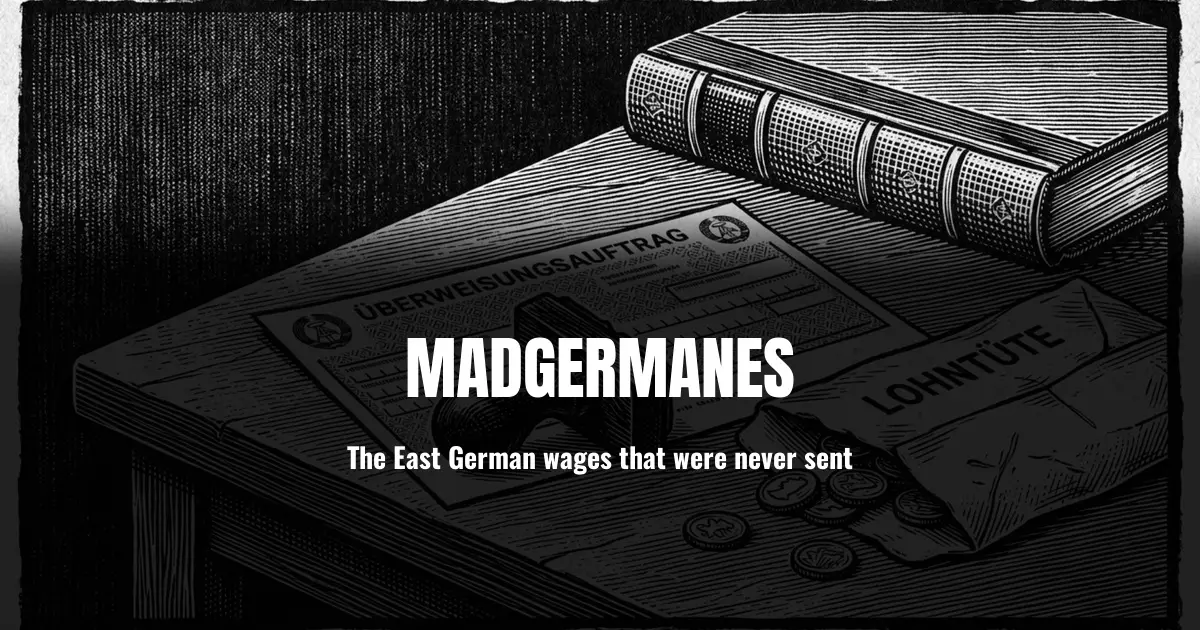
# Madgermanes: The East German Wages That Were Never Sent
Every Saturday in Maputo, for more than thirty years, a group of ageing men and a few women have gathered in a park to ask for money they earned in the 1980s. They call themselves the Madgermanes, from „Made in Germany“ with a twist of „mad,“ and they worked in the meat plants, open-cast mines and textile mills of the German Democratic Republic between 1979 and 1990. Part of their wages was deducted every month and, their contracts said, sent home to a bank account in their name. The accounts did not exist. The money did not go home. And the two states involved, reunified Germany and Mozambique, have each said for three decades that the other one has it.
This is an East German story, and it is almost unknown in English. The archives that tell it are in Berlin, in German, and the people who lived it are in Maputo, Beira and Nampula.
The arrangement
By 1977 the GDR was close to insolvency in hard currency. Hans-Joachim Döring, whose reconstruction from the federal archives is the basis of the bruderland.de account, describes the response: an „African export offensive“ run by Alexander Schalck-Golodkowski’s Commercial Coordination department, aimed at three newly independent countries that traded in dollars, Angola, Ethiopia and Mozambique. In February 1979 Erich Honecker went to Maputo and signed more than eighty agreements with Samora Machel, among them one to bring Mozambican workers to the GDR. Mozambique, independent since 1975 and at war with the South African-backed Renamo, had young people and no jobs; the GDR had jobs and, as its own citizens left, no young people.
Mozambique’s debt to the GDR grew fast in the following years, at above-market interest. In 1986, Döring writes, Schalck-Golodkowski set new targets: the debt would be worked off by a stepped-up migration of Mozambican labour, 4,500 additional workers within a year, with nothing prepared on either side to receive them. The total number who came over the decade is given variously as 15,000, 16,000 and around 21,000, depending on who is counting and whether trainees are included. Marcia Schenck, who has interviewed returnees for a decade, works with the upper figure. In 1988 planners in Berlin were talking about 90,000 by 1990.
The deduction
From 1979 to 1985, a flat 25 percent of each worker’s net monthly wage was withheld. From 1986 the rate was 60 percent of everything above a basic 350 marks. The procedure was fixed in a „transfer order“ of 8 May 1987, which survives in the Bundesarchiv under file DQ3-2131 together with the template of the contract each worker signed. The template authorises the employer to retain the 60 percent and to transfer it, for the worker’s benefit, to an account opened at the Banco de Moçambique.
The company deducted the sum, passed it to the GDR finance ministry, and the finance ministry put it at the disposal of Commercial Coordination for offsetting debt. A former official of the State Secretariat for Labour and Wages said at a conference in Magdeburg in 2019 that from the beginning the „transferred“ sums were not sent to Mozambique but booked against Mozambique’s debt, and that this was done „by mutual consent.“ I quote the three words because they are the whole legal position of both governments, then and now: the money was not stolen, it was settled. Between states. Without telling the people whose wages they were.
The workers were not informed. Their contracts said the opposite. Schenck calls the remittance „a fiction.“ When they went home in 1990 and 1991, most of them expelled after reunification ended the treaties, they found no accounts, no savings, and a country still at war where the trades they had learned were not wanted.
The numbers that do not fit
Here the story splits into figures that were never meant to be compared.
The German Foreign Office, according to a 2009 investigation by the magazine Brand eins, states that the GDR transferred 74.4 million US dollars in wage deductions and 18.6 million in social insurance contributions to Mozambique, 93 million in all. Divided across roughly 20,000 workers, that is about 4,500 dollars each. In 1993 the Federal Republic sent Mozambique a further lump sum of around 75 million Deutschmarks for the workers‘ services. On that basis Berlin has said, consistently, that all claims are settled, and the Mozambican embassy in Berlin has said that all the money reached Mozambique.
The activists in Maputo put the outstanding claim at more than 600 million euros. DOMiD, the German migration museum, repeats the figure without endorsing it.
Between 93 million dollars and 600 million euros there is no arithmetic bridge, because the two numbers answer different questions. The 93 million is what the GDR’s own books record as credited to Mozambique’s account, in a non-convertible currency valued at whatever rate the ledger used; nobody has published the rate. The 600 million is a reconstruction of what 20,000 people should have received at 25 to 60 percent of East German net wages over up to a decade, plus pension entitlements from a decade of contributions to a social insurance system that no longer exists. One is a settlement between treasuries. The other is a sum of individual wage claims. The first has been paid, in the sense that a debt was cancelled. The second has never been paid to anyone.
And in Maputo the question of what Frelimo did with the debt relief, or with the 1993 lump sum, has never been answered in public. A Mozambican returnee interviewed by the former GDR development worker Rainer Grajek put it simply: the government used it to pay debts or import goods, and most of the workers went away empty-handed.
Where it stands
The Madgermanes occupied the German embassy in Maputo for a few hours in 2004. They have demonstrated every week since the early 1990s and are treated in Mozambique as troublemakers. In September 2024 the German federal commissioner for the victims of the SED dictatorship, Evelyn Zupke, called for a Bundestag resolution recognising the injustice and a lump-sum payment to the roughly 10,000 former workers still alive; the German Institute for Human Rights suggested up to 6,000 euros each, and said the gesture mattered more than the sum. The Foreign Office’s position that the claims are settled has not changed. Around 1,500 children born to Mozambican fathers in the GDR grew up without them.
What doesn’t add up
**A transfer that was never a transfer.** The contracts promised individual accounts in Maputo. The internal order routed the money to a ministry in Berlin for debt offsetting, „by mutual consent“ of two governments, and this was known to officials from 1979. So the document the worker signed and the document the state acted on say different things, and both survive in the same archive file. Germany’s defence, that the money reached Mozambique, is true only if a cancelled debt counts as money reaching a person. What would settle it: the exchange rate and the account entries behind the Foreign Office’s 74.4 million, published; and Mozambique’s side of the same ledger, which the Banco de Moçambique and the finance ministry in Maputo have never opened.
**Two states, one liability, no owner.** Germany says it paid Mozambique. Mozambique says it received the money for the state, not for the workers, or says nothing. Each answer is consistent with the files each side holds, and each leaves the wage unpaid. The GDR no longer exists; the Federal Republic accepted its treaties but not, it argues, this debt to individuals; Frelimo has governed Mozambique without interruption since 1975 and has never accounted for what it did with the offset. What would settle it: not a document, since the documents exist, but a joint reckoning the two governments have declined for thirty years, of the kind Zupke asked for in 2024.
What stays open
What rate turned East German marks into 74.4 million dollars. What Mozambique did with the debt relief and with the 1993 payment. Whether the pension contributions, which were real deductions into a real system, will ever be honoured by the system’s legal successor. And whether the men in the park in Maputo, most now past sixty, will be paid by anyone before there are none left to pay.

KardiKassin
Writes about Africa’s history and how it gets told, sourced and checked at every step.
Made in Germany: How Your Picture of Africa Was Manufactured
Two governments, two ledgers, and a wage that both sides call settled. The free 12-page ebook follows that same kind of gap between the record and the person across a whole continent’s worth of history.
Sources
- Döring, Hans-Joachim: From Contract Workers to „Madgermanes“ (extract from „Bittere Solidarität, fehlende Anerkennung, offene Rechnungen“, Gerbergasse 18, 2/2019), with facsimiles of BArch DQ3-2131. bruderland.de. https://bruderland.de/en/background/from-contract-workers-to-madgermanes/
- Schenck, Marcia C.: From Luanda and Maputo to Berlin. African Economic History 44 (2016), pp. 202 to 234; and A Chronology of Nostalgia. Labor History 59 (3), 2018, pp. 352 to 374
- DOMiD, Documentation Centre and Museum of Migration in Germany: „Contract worker“ in the GDR. https://domid.org/en/news/contractwork-in-the-gdr/
- Heß, Asmus: Das große Warten. Brand eins 6/2009 (the Foreign Office figures of 74.4 and 18.6 million US dollars), cited via Kunstverein Schwerin, Madgermanes / Mystery of Foreign Affairs, 2017. https://kunstverein-schwerin.de/en/2017/madgermanes-mystery-of-foreign-affairs
- AFP via News24: East Germany’s Mozambican workers in fresh push for lost pay, 30 September 2024 (Zupke, the 1993 lump sum, the 10,000 survivors). https://www.news24.com/business/economy/east-germanys-mozambican-workers-in-fresh-push-for-lost-pay-20240930