
Streit um den Rundfunkbeitrag: Warum wir über Geld reden, wenn wir Zugehörigkeit meinen
2. September 2026
Gewalt gegen Migranten in Südafrika: das Herkunfts-Paradox
4. September 2026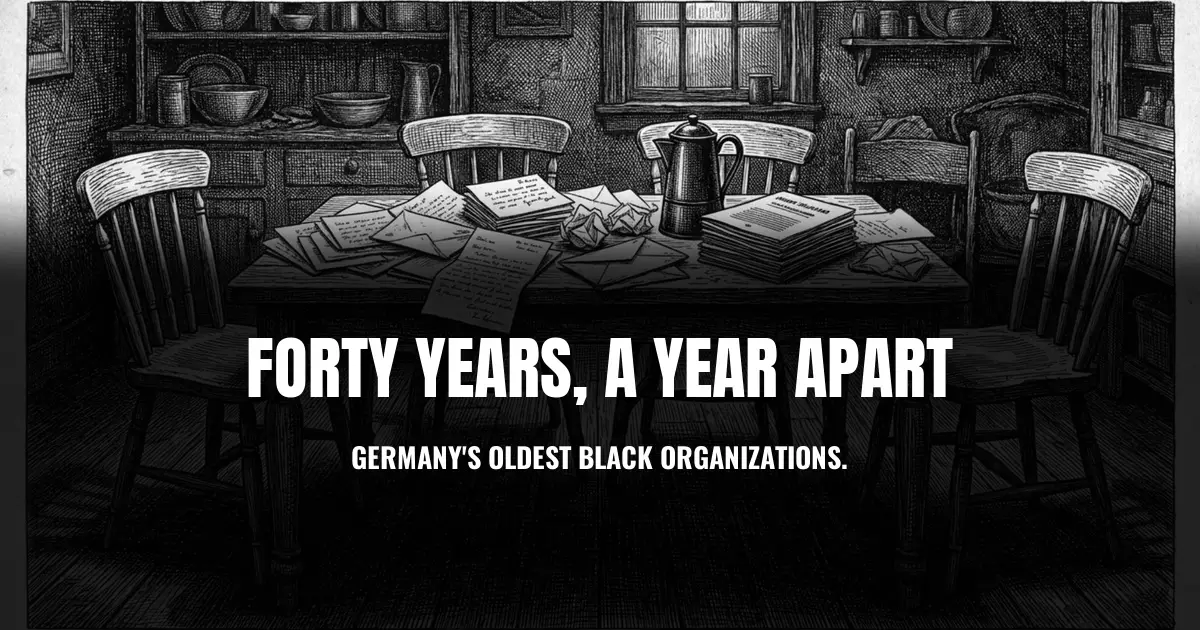
Germany’s two oldest Black self-organizations are both turning forty, and not in the same year. The Initiative Schwarze Menschen in Deutschland says on its own website that it has existed since 1985. Adefra was founded in 1986. Two organizations, two anniversaries, twelve months apart.
That gap is the easy part. The harder thing is that the movement built specifically to write Black German history in its own words has left its own founding thinly documented, and the reporting around the anniversary does not agree with itself.
A book, a meeting, a name
Audre Lorde, the Caribbean-American poet and theorist, spent time in West Berlin from the mid-1980s onward. The Berlin state museums date the political self-designation Afro-German to her work with a circle of Black women activists there. Adefra’s own account puts it the same way: Lorde drew the existing contacts between Black women in Berlin together, and out of that came the impulse to found something. The nd writer Martin Höfig, in a piece marking the anniversary in November 2025, calls her influence on the emergence of ISD substantial.
In 1986, the same circle founded Adefra. The name carries an Amharic sense that the association translates as the woman who shows courage. That same year, May Ayim, Katharina Oguntoye and Dagmar Schultz published Farbe bekennen, built partly on Ayim’s own university thesis and on family histories reaching across several generations of Afro-German and Black women. It was the first book in which Black German women placed themselves in history rather than being placed there.
ISD came out of a different room. A nationwide meeting of Black Germans in Wiesbaden in 1985 produced a standing organization, the one that now calls itself Initiative Schwarze Menschen in Deutschland. A circular letter sent round to participants afterwards recorded what the meeting had done: putting the experience into words, one attendee wrote, set something moving in nearly everyone who had been there.
What they were organizing against
Both groups named the same target. Not only the racism Black people in Germany met day to day, but the wider refusal in West German public life to concede that Black German history existed at all, or that the country carried any responsibility for what had been done under colonialism and under National Socialism.
That refusal rested on an assumption that Black presence in Germany was recent. ISD co-founder Abenaa Adomako’s family is the direct counterexample. Her great-grandfather came to Germany from Cameroon in 1891, and the family has lived there for five generations since. Most of the people who built ISD and Adefra had nothing like that behind them. Many had grown up as the only Black person in their surroundings well into adulthood, with no elders and no shared history to reach for while they were looking for one.
Built at a kitchen table
The early work happened in private flats, not institutions, and the movement’s own later scholarship kept that image on purpose. Faheem Hemboum, writing in analyse und kritik in November 2025, describes it as thinking done at the kitchen table by what one academic account calls quotidian intellectuals, women building a political analysis without a university behind them.
The phrase is doing more work than it looks. A kitchen table is where you end up when no institution will host you, and it also decides who gets counted as a thinker. The analysis these women produced was not published in journals, so for years it existed mainly in conversation, in circular letters and in magazines the movement printed itself. That is the reason the founding is hard to date now, and it is also the reason the founding happened at all.
Growth was local and uneven. Tahir Della, a former ISD board member, has described a Munich group forming in 1987 and working alongside the African students‘ union and other nationally organized African groups. Activists in Frankfurt connected in the 1990s with Young Black Souls, teenagers with African parents finding their own footing. The founding generation came from sharply different starting points inside the same movement: some from families with a century of German history behind them, others recent migrants, students, refugees or contract workers, each with a different relationship to language, class and the freedom to move between countries.
From 1988 two magazines carried the ideas further, Afrekete and afro look. Berlin held an annual Black History Month from 1990 to 2001, tracing back to the initiative of the American historian Carter G. Woodson. A youth project called Blite gave Black teenagers a place to research and write about Black life themselves.
Forty years on
In 2025, ISD, Adefra and other civil society groups handed Berlin’s culture senator Sarah Wedl-Wilson a citywide remembrance concept on colonialism, years of research and advocacy compressed into one policy document. Where that document goes next depends on a cultural policy whose record on colonial-era restitution is still being tested elsewhere.
Not every strand of this history resolved cleanly. Some of the earliest activists eventually built their lives outside Germany. Others did not survive the isolation the movement had set out to end. The relationship between Black Germans and the country itself stays unsettled in a basic way, and that question of belonging is the one the founders were already arguing about at the kitchen table: home without question for some, a biographical footnote for others.
What doesn’t add up
Three things sit oddly inside a history that is otherwise well told.
The first is a straight collision in the reporting. Two German outlets marked this anniversary twelve days apart in November 2025, and they date the movement’s founding book differently. Hemboum in analyse und kritik puts Farbe bekennen in 1986. Höfig in nd calls it a collection from 1990. Both cannot be right, and it matters more than a typo would, because the book is the object that dates the movement’s self-documentation. If it appeared in 1986, it lands between the two foundings and reads as the movement’s opening statement. If it appeared in 1990, it is a retrospective. What would settle it is the imprint of the first edition. Neither article reproduces it.
The second is the dating itself, and it runs the other way from what you would expect. ISD states 1985 on its own site. Adefra’s own site names no founding year at all, only impulses in the mid-1980s. The precise year, 1986, comes from outside the movement: the Museum Europäischer Kulturen fixed it by mounting a twentieth-anniversary exhibition in 2006. So the organization founded to stop others from narrating Black German history has, on its own pages, a vaguer founding date than a state museum supplied. That is not a scandal, it is what happens when the work is activism rather than record-keeping. It is still worth naming, because the movement’s own central charge was that the archive belonged to somebody else. What would settle it is Adefra’s entry in the association register, or the minutes of the Wiesbaden meeting for ISD. None of the anniversary coverage read here cites either.
The third thing is the sequence. The Rosa Luxemburg Foundation, in a 2022 account by Femi Awoniyi, describes Farbe bekennen as the book that inspired the founding of ISD and other Black groups. ISD says since 1985, and the book appeared in 1986. An organization cannot be founded in response to a book that has not been published yet. The likeliest reading is that 1985 marks the Wiesbaden meeting and not the founding of the association, which would make all three statements compatible and would also explain why the year is reported two ways. Nobody says that anywhere. What would settle it is a statement from ISD separating the meeting from the formal founding, or its entry in the association register.
What stays open
Forty years is long enough that the founding generation is no longer the generation doing the work. The organizations are still here, which is the part almost nobody predicted in a country that spent the 1980s insisting there was no such thing as a Black German. What has not caught up is the record: two websites, two anniversary articles, a museum exhibition and a foundation’s account, and no two of them agree on the same set of dates.
Does it matter more that ISD and Adefra cannot fix their own starting point precisely, or that both are still here to be asked about it?
This piece is also available in German.
Sources
- Faheem Hemboum, „Neuanfang am Küchentisch: Vor 40 Jahren entstanden mit ISD und Adefra zwei Vereine, die das Selbstbild mehrerer Generationen Schwarzer Menschen prägten,“ analyse und kritik 720, 18 November 2025. https://www.akweb.de/bewegung/40-jahre-isd-und-adefra-wie-zwei-vereine-das-selbstbild-mehrerer-generationen-schwarzer-menschen-in-deutschland-praegten/
- Martin Höfig, „ISD: Schwarze Selbstermächtigung,“ nd-aktuell, 30 November 2025. https://www.nd-aktuell.de/artikel/1195853.isd-schwarze-selbstermaechtigung.html
- Museum Europäischer Kulturen, Staatliche Museen zu Berlin, exhibition „Generation Adefra: 20 Jahre Schwarze Frauenbewegung in Deutschland,“ 23 September to 22 October 2006. https://www.smb.museum/en/museums-institutions/museum-europaeischer-kulturen/exhibitions/detail/generation-adefra-20-years-of-the-black-womens-movement-in-germany/
- Adefra e.V., own account of the organization’s origins. https://adefra.com/
- Initiative Schwarze Menschen in Deutschland, own account of the organization. https://isdonline.de/
- Femi Awoniyi, „How Black People in Europe Began to Organize,“ Rosa Luxemburg Foundation, 21 June 2022. https://www.rosalux.de/en/news?tx_news_pi1%5Baction%5D=detail&tx_news_pi1%5Bcontroller%5D=News&tx_news_pi1%5Bnews%5D=46711&tx_news_pi1%5Bnews_uid%5D=0&cHash=cc6c8466c6cf84966658c08cc25156e5