
Warum China verbietet, was es nach Deutschland exportiert
28. August 2026
Chief Mkwawa’s Skull Was in the Treaty of Versailles. His Tooth Was Not.
30. August 2026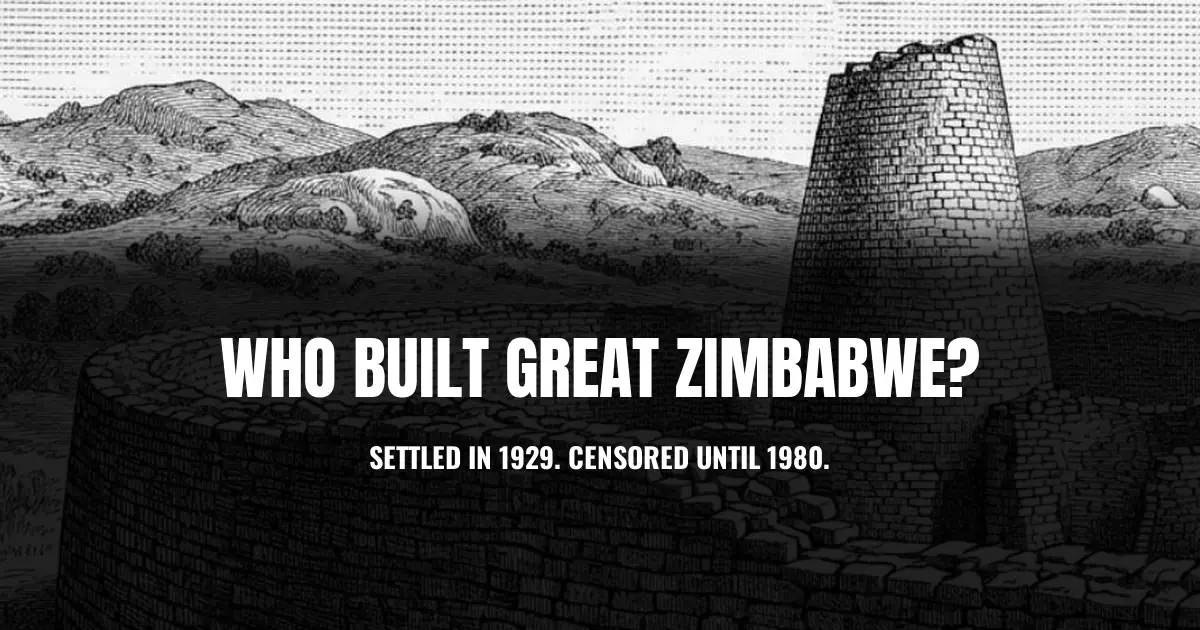
A member of the Rhodesian parliament once asked a minister to censor a guidebook. Its crime was one sentence: it said Africans built Great Zimbabwe. George Holland Hartley was elected in 1962 for the constituency that contained the ruins. He argued that local Africans could not have built them, and he wanted the book pulled from circulation. The archaeological case for African authorship was, by then, more than thirty years old.
A trading city, not a legend
Great Zimbabwe sits on the plateau between the Zambezi and Limpopo rivers, in what is now southeastern Zimbabwe. Its walls were raised without mortar, from cut granite blocks. They went up in stages between roughly the eleventh and fifteenth centuries, and they were built by the ancestors of the Shona people, most likely the Karanga. The largest structure, known as the Great Enclosure, is a curved wall over 250 meters around and close to ten meters high, built from almost a million dressed stones. At its height the city anchored a trade network. Gold and ivory went to the Indian Ocean coast. Glass beads and porcelain came back, some of it shipped from as far away as China.
Great Zimbabwe was not an isolated monument. It was the largest of several hundred related stone-walled sites scattered across the region, sometimes grouped by archaeologists under the label Zimbabwe culture. Even the settled parts of this history are still being refined. Older estimates put the city’s peak population as high as 18,000. Shadreck Chirikure and colleagues then modelled homestead numbers against ecological limits. They argue for something closer to 8,000 at the peak. For the whole 800 years of occupation, once generational turnover is counted, they put the ceiling at 10,000.
The earliest written mention of the site comes from a Portuguese sea captain, Vicente Pegado, who recorded a secondhand account from Arab traders in 1531. For roughly three centuries after that, Europeans knew the site mostly as rumor.
A theory arrives before the dig does
European interest in the ruins picked up in the nineteenth century, and the theories that took hold were built on almost no excavation at all. Alexander Merensky, a German missionary with the Berlin Missionary Society, popularized a legend in the 1860s connecting the site to the biblical land of Ophir and the mines of King Solomon. His friend Karl Mauch, a German explorer credited as the first European to reach the ruins in 1871, arrived already persuaded, and recorded in his journal that the structure reminded him of Solomon’s temple in Jerusalem. The comparison stuck for decades. Later writers floated Egyptian, Phoenician, and even shipwrecked-Viking origins, none of them resting on more evidence than Mauch’s had.
Twenty years later, the archaeologist Theodore Bent led an expedition on behalf of the Royal Geographical Society. Bent noticed carved soapstone birds that reminded him of art he had studied in the Near East. On that basis he concluded the ruins were Phoenician, and that Africans had arrived only after the original builders left. It was a conclusion useful to the colonial project already underway around it. Cecil Rhodes’s British South Africa Company was in the process of claiming the same land the ruins sat on, and a non-African origin story made that claim easier to defend. The same pattern runs through much of what this site covers under colonial history. The account of a place and the claim to it tend to arrive together.
When the evidence arrived anyway
The first careful excavation came in 1905, when David Randall-MacIver spent a season digging at seven related sites, concentrating on Great Zimbabwe itself. He published the following year, as Mediaeval Rhodesia. The walls were the work of the Shona, he concluded, and far more recent than the Solomon legend required. He dated them to no earlier than the fourteenth century. By his own account it ran directly counter to popular opinion, and it was received as controversial rather than settled.
It took another excavation, led by Gertrude Caton-Thompson with an all-female team in 1929, to close the question with detailed stratigraphy. Her report, published in 1931 as The Zimbabwe Culture, described the ruins as African in every particular, and reached the same conclusion Randall-MacIver had published twenty-five years earlier.
Sixty years of enforced doubt
After 1929 the argument should have been over. Instead the answer was suppressed, deliberately and for decades. Ian Smith’s Rhodesian Front declared unilateral independence from Britain in 1965. Its government was built to keep power from the African majority, and it treated the authorship of Great Zimbabwe as a matter of state. Guidebooks, museum displays, school textbooks, radio programs and films discussing the site were censored to remove or soften the African origin.
The pressure reached individual careers. Peter Garlake was Inspector of Monuments from 1964 to 1970 and had published the settled conclusion plainly. He resigned in 1970 rather than present the settler theory as an equal alternative to what two excavations had already shown. Then he left for a research post at the University of Ife in Nigeria. He returned to Zimbabwe after independence and spent the following decade working on the country’s rock art. His 1973 book Great Zimbabwe was written from outside the country whose central monument it described.
Renamed, and still contested
In 1980, the country renamed itself Zimbabwe, from the Shona dzimba dza mabwe, houses of stone. Theodore Bent had once used the soapstone bird as evidence of a foreign builder. It now appears on the national flag and on the currency, carrying exactly the heritage it was once assembled to deny.
Vindication did not settle every tension around the site. Joost Fontein set this out in the Journal of Southern African Studies in 2006. People living near Great Zimbabwe, he found, describe the fenced heritage site and the bureaucracy running it as another form of exclusion. In those accounts the line between the treasure hunts of the early antiquarians and the careful excavations that followed is not a sharp one. Both, in local accounts, disturbed a place that was never meant to be a museum piece. Being proven right about who built the walls did not automatically return the walls to the people who raised them.
What doesn’t add up
Two things about this story sit oddly next to each other, and neither needs a missing document to notice.
The evidence was never the problem
The first is that the evidence was never actually behind the denial. Randall-MacIver in 1906 and Caton-Thompson in 1931 reached the same conclusion, a quarter century apart, using methods that held up under later scrutiny. The Solomon and Phoenician theories that competed with them rested on a legend and a handful of carved birds, with no excavation behind either. This was never a contest between two thin cases. One side dug, the other speculated, and for most of a century the speculation was treated as the more credible of the two. Nothing evidential was missing that a further excavation could have supplied. What was missing was a reason to accept what two excavations had already shown. That changed in 1980, because independence removed the political incentive to prefer the weaker case.
What the prospectors took with them
The second is that some of what a fuller excavation might have shown is simply gone. Early prospectors working for Rhodes’s company dug through burial areas looking for gold. They melted down metal objects on the spot, and they discarded pottery and iron tools they judged unimportant. No inventory of what was destroyed survives. So what those objects might have added to the trade history of the site cannot now be recovered. A surviving customs record or a full catalogue of the early digs would settle it. Neither exists.
Zimbabwe carries the answer in its own name. What stays open is narrower. How large was the city at its peak? What drove its decline in the fifteenth century? How far did its trading network reach beyond the routes historians have already traced? Those are the questions a site gets to ask once the argument over its existence is finally over, and the African kingdoms covered here keep raising them.
How many other sites are still being called mysteries, decades after the mystery was actually solved?
Sources
- David Randall-MacIver, Mediaeval Rhodesia. Macmillan, 1906.
- Gertrude Caton-Thompson, The Zimbabwe Culture: Ruins and Reactions. Clarendon Press, 1931.
- Peter S. Garlake, Great Zimbabwe. Thames and Hudson, 1973.
- Shadreck Chirikure and others, „What was the population of Great Zimbabwe (CE1000 to 1800)?“, PLOS ONE 12(6), 2017. https://journals.plos.org/plosone/article?id=10.1371/journal.pone.0178335
- Joost Fontein, „Silence, Destruction and Closure at Great Zimbabwe: Local Narratives of Desecration and Alienation“, Journal of Southern African Studies 32(4), 2006, pages 771 to 794. https://www.tandfonline.com/doi/abs/10.1080/03057070600995723
- Henrika Kuklick, „Contested Monuments: The Politics of Archaeology in Southern Africa“, in George W. Stocking (ed.), Colonial Situations. University of Wisconsin Press, 1991.
- Innocent Pikirayi, „Peter Garlake (1934 to 2011), Great Zimbabwe and the politics of the past in Zimbabwe“, Azania: Archaeological Research in Africa 47(2), 2012. https://www.tandfonline.com/doi/full/10.1080/0067270X.2012.682779