
Artisanaler Goldbergbau: Wer traegt das Risiko?
18. September 2026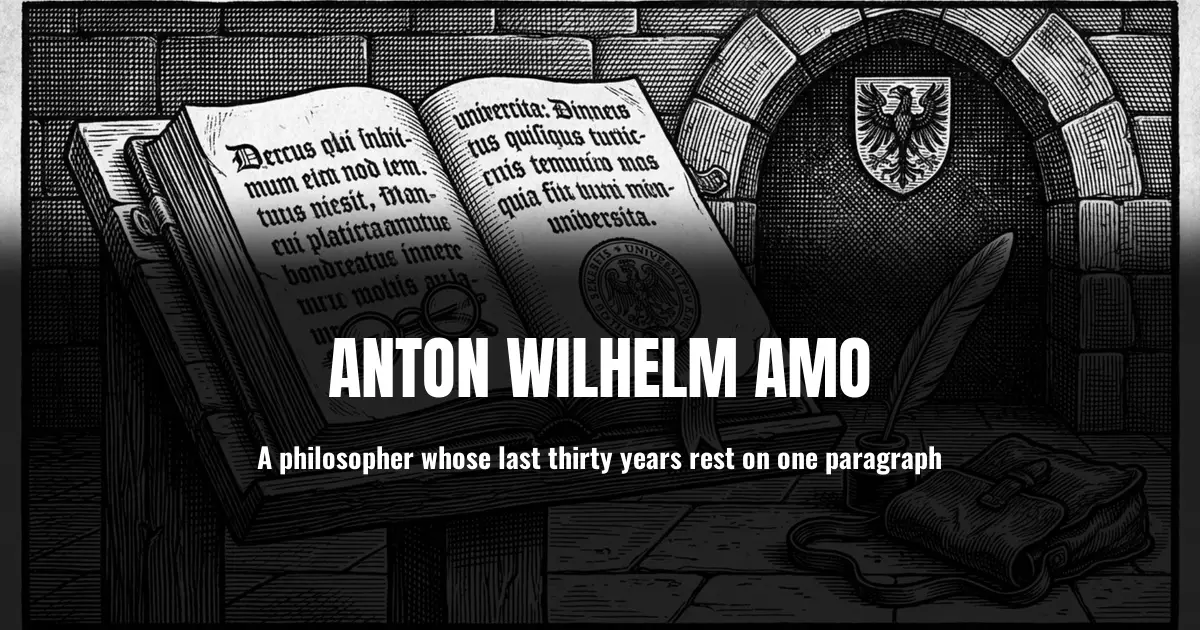
# Anton Wilhelm Amo: A Philosopher Whose Last Thirty Years Rest on One Paragraph
There is a bronze plaque on the Universitätsring in Halle, placed in 1975, that calls Anton Wilhelm Amo the first African student and lecturer in philosophy at the universities of Halle, Wittenberg and Jena, 1727 to 1747. Those dates are documented to the day: matriculation registers, a printed dissertation, a faculty admission dated 21 June 1736. The plaque stops at 1747 because the documents do. Amo lived perhaps thirty more years. What is known about them fits in a paragraph, and that paragraph was written by a man who never met him.
What the German archives hold
Amo was brought to Europe as a child, probably around 1707, and given to the ducal court of Brunswick-Wolfenbüttel. He was baptised at the Salzdahlum chapel in 1708 and raised and educated at the court’s expense. In 1727 the court sent him to Halle, where he enrolled in philosophy and law. In November 1729 he held a disputation titled De iure Maurorum in Europa, on the legal position of Africans in Europe. The text is lost. Its content is known only from a notice published the same month by his patron, the Halle chancellor Johann Peter von Ludewig, in the Wöchentliche Hallische Frage- und Anzeigungs-Nachrichten. According to that notice, Amo argued against the enslavement of Africans on European soil. The first foundation stone of the Amo story, then, is already a summary by someone else.
From 1730 he was at Wittenberg, where he took a master’s degree within six weeks and began lecturing. In 1734 he defended his doctoral dissertation there, De humanae mentis apatheia, a treatment of the mind-body question that argues the mind cannot suffer or sense, since sensation belongs to the living body. In 1738 he published in Halle the Tractatus de arte sobrie et accurate philosophandi, a textbook of logic and method. Both works survive and have been translated. On 21 June 1736 the Halle philosophy faculty admitted him as a lecturer; in 1739 he was teaching in Jena.
Then the record thins. Ludewig died in 1743. In 1747 a Halle professor of rhetoric, Johann Ernst Philippi, published a set of mocking verses about Amo, racist in content, that circulated in the town. The Martin Luther University’s own Amo page says little is known of the years before this and that the poem „cast a shadow“ over his situation. Sometime in or after 1747 he left Germany. No document records his departure, his route, or his ship.
The paragraph
Everything after that comes from Isaac Winckelman. In 1782 Winckelman wrote an obituary for the physician David Henri Gallandat, a Swiss who had served as ship’s surgeon on Dutch West India Company voyages and later became a founder of the Zeeland Society of Sciences at Flushing. The obituary, printed in the Society’s Verhandelingen, volume 9, pages 19 to 20, includes a passage about a stop at Axim on the Gold Coast, dated to Gallandat’s second voyage in 1753. There, Winckelman writes, Gallandat went to see „the famous mister Anthony William Amo.“ I quote the phrase because it is the one piece of independent evidence that Amo’s reputation had travelled: a Dutch surgeon in 1753 knew whom he was looking for, and a Zeeland gentleman in 1782 expected his readers to as well.
The rest of the passage, in Burchard Brentjes’s German translation, gives the following. Amo was about fifty. He had been in Amsterdam in 1707 and had spent about thirty years in Europe. He had been given to the Duke of Brunswick. His father and a sister were still alive and lived four days‘ journey inland. He had a brother who was a slave in the colony of Suriname. He now lived as a hermit and had the reputation of a soothsayer. Later he moved from Axim and took up residence in the West India Company’s Fort San Sebastian at Shama.
That is the whole of it. Winckelman quotes Gallandat’s diary directly for a storm on the first voyage, then tells the Amo encounter in his own words, so it is not clear how much of the passage is Gallandat’s note and how much is Winckelman’s memory of it thirty years on. The chronology inside the paragraph is already loose: Winckelman dates the visit to 1753 but places that voyage one year after the 1751 voyage. Thirty years in Europe does not fit 1707 to 1747, which is forty. Both are the kind of rounding a man makes when writing from someone else’s notes.
The Shama sentence comes last, in Winckelman’s voice, and refers to something after 1753. Whether Gallandat learned it on a later voyage, or Winckelman had it from another source, the text does not say. Later writers have supplied a motive, that the Dutch moved Amo into the fort to keep him from stirring up the coast, and that motive appears in more than one modern account. No document supports it. The source says he took lodging there. It does not say why, or whether he chose to.
The gravestone
At Shama today there is a headstone for Amo outside the fort. It gives the year of death as 1784. The stone is modern. No burial register, no Company record and no earlier marker has been found that states when he died, where, or of what. The Wittenberg university’s biographical page says „probably in the 1750s“; the Shama stone says 1784; a careful account says unknown. All three are compatible with the evidence, because the evidence ends in 1753.
Why it is remembered the way it is
Brentjes, an archaeologist of the Near East at Halle, assembled the documents in 1968 for an East German university that wanted an anti-colonial founding figure, and published the short biography that fixed Amo’s image in 1976. The 1975 plaque, the 1965 facsimile volume and the annual Amo Lectures since 2013 all descend from that effort. It was serious work, and it is why the German half of the life is so well documented. It also set the shape of the story: an African scholar received, honoured, then driven out by racism, who returned home and vanished. That shape is not wrong. It is just that the second half of it, the driven-out and the vanished, rests on a Halle satire whose effect nobody recorded and a Dutch paragraph written from notes.
What doesn’t add up
**A thirty-year life reconstructed from one secondhand paragraph.** Winckelman was not on the Gold Coast. Gallandat was, but his diary for that passage is not quoted and does not survive independently. Every fact about Amo after 1747, the hermit’s life, the reputation as a seer, the family inland, the enslaved brother, the move to Shama, comes through a single chain: Gallandat’s notes, Winckelman’s rewriting in 1782, Brentjes’s translation in the 1960s. The claim about a forced removal to the fort is not even in the chain; it was added later. What would settle it: the Dutch West India Company kept garrison and ration lists for its Gold Coast forts, now in the Nationaal Archief in The Hague, and a lodger of Amo’s standing at Shama in the 1750s or later would plausibly appear in them. Nobody has published a search.
**Two lost texts at the two ends.** The disputation of 1729 that made Amo’s name is known only from Ludewig’s newspaper notice; the visit of 1753 that closes the record is known only from Winckelman’s obituary. The one surviving philosopher is the one in the middle, in the two Latin books of 1734 and 1738. Modern readers who want Amo as an early critic of slavery are citing a summary of a lost argument; readers who want him as a tragic exile are citing a summary of a lost diary. What would settle the first: a copy of the 1729 disputation, which was printed and may survive in a library that has not catalogued it. What would settle the second: Gallandat’s own papers, if any passed to the Zeeland Society.
What stays open
When Amo died, where he is buried, whether he chose the fort or was put there, whether he ever taught again. A philosopher who left two books and a plaque in one country and a headstone with a guessed date in another. The German archives have been read. The Dutch ones, for this question, have not.

KardiKassin
Writes about Africa’s history and how it gets told, sourced and checked at every step.
Made in Germany: How Your Picture of Africa Was Manufactured
Thirty years of a life, reduced to one secondhand paragraph someone else wrote down. The free 12-page ebook traces that same kind of narrowing across a whole continent’s worth of image-making.
Sources
- Winckelman, Isaac: obituary of David Henri Gallandat, in Verhandelingen uitgegeven door het Zeeuwsch Genootschap der Wetenschappen te Vlissingen 9 (1782), pp. 19 to 20; German translation of the Amo passage in Brentjes 1976
- Brentjes, Burchard (ed.): Antonius Guilielmus Amo Afer aus Axim in Ghana. Dokumente, Autographe, Belege. Halle: Martin-Luther-Universität, 1968; and Brentjes, Burchard: Anton Wilhelm Amo. Der schwarze Philosoph in Halle. Leipzig: Koehler und Amelang, 1976
- Martin-Luther-Universität Halle-Wittenberg: Anton Wilhelm Amo, documentation page of the Rectorate Commission. https://www.amo.uni-halle.de/
- Leucorea, Universität Wittenberg: Anton Wilhelm Amo, biographical timeline. https://www.uni-wittenberg.de/kollegen/amo-anton-wilhelm/