Warum wir uns vorstellen, die Sahara sei schon immer Wüste gewesen
25. Oktober 2026
Das Rad in Westafrika: Bekannt, aber jahrhundertelang liegen gelassen
30. Oktober 2026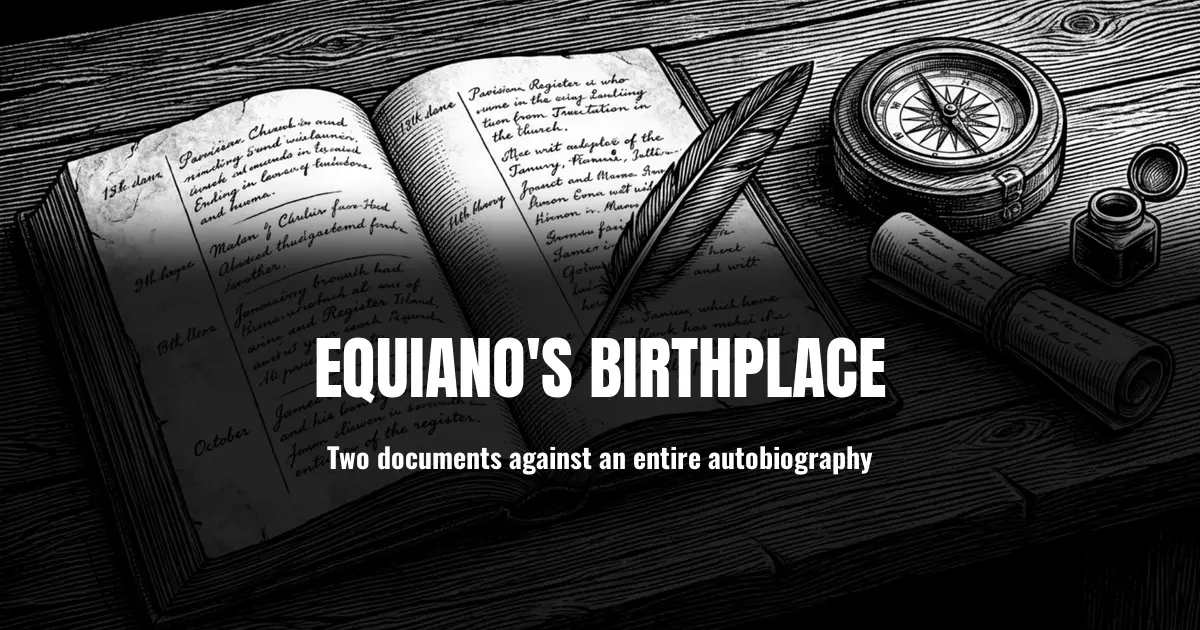
# Equiano’s Birthplace: Two Documents Against an Entire Autobiography
Olaudah Equiano’s 1789 autobiography, The Interesting Narrative, is the most influential first-person account to survive the transatlantic slave trade: a childhood in an Igbo village he calls Essaka, capture, the Middle Passage, enslavement in Virginia and the Caribbean, purchase of his own freedom, a career at sea that included an Arctic expedition, and years as a leading voice of the British abolition movement. For two centuries it was read as exactly what it claimed to be.
In 1999, and at length in his 2005 biography, the literary scholar Vincent Carretta produced two eighteenth-century documents that say something different. The debate that followed has never fully settled, and one of the two documents may be weaker than it first appears.
What the two documents say
The first is a parish baptismal record from St Margaret’s, Westminster, dated 9 February 1759. It describes a twelve-year-old identified as „Gustavus Vassa,“ the name given to Equiano by his enslaver, as, in the register’s words, a Black born in Carolina. The second is a 1773 muster roll from a Royal Navy Arctic expedition on which a birthplace of South Carolina is recorded for a sailor.
Carretta’s argument, made most fully in Equiano the African and defended again in a 2007 direct reply to his critics, treats the two documents as independent corroboration of each other. Applying what he calls the principle of parsimony, he judges it simpler to conclude that Equiano was actually born in South Carolina around 1747 and invented an African childhood and a Middle Passage crossing he never experienced, drawing the vivid ethnographic detail of Essaka from published sources available to him in London, than to explain away two official records that both point away from Africa. Carretta has been explicit, including in interviews, that he regards this as strong circumstantial evidence rather than proof, and has suggested a political motive: the abolition campaign of the 1780s needed a living witness to the Middle Passage, and an African-born narrator served that need in a way a Carolina-born one would not.
Lovejoy’s answer, and the case for Africa
Paul Lovejoy, a historian of the West African slave trade, challenged Carretta’s reading directly in a 2006 article and returned to the question in a much longer 2024 study identifying Equiano’s remembered home village, Essaka, with a specific place, Usaka, in today’s Abia State, Nigeria, matching it to the clan structure and naming conventions Equiano describes. Lovejoy’s case does not deny that the two documents say what they say. It argues that everything else about Equiano’s account, his description of Igbo facial markings, his apparent command of Igbo cultural detail, the fit between his given name and Igbo naming patterns, and the coherence of his stated age at the time of capture with datable events in the Bight of Biafra slave trade of the 1750s, is difficult to explain unless he had genuinely lived the childhood he described. Lovejoy accepts, in his own words, that the existence of independent documents stating a Carolina birth appears to be conclusive proof against an African birth, and then argues that the weight of everything else should be read as outweighing that appearance.
The problem with the second document
A challenge to Carretta’s case, raised on the Equiano’s World research project associated with Lovejoy’s circle, targets the 1773 muster roll specifically rather than the general balance of probability. The name recorded on that document, according to this reading, is not Gustavus Vassa but Gustavus Weston, a different name that a ship’s clerk transcribing dozens of sailors‘ details would be unlikely to have confused with Vassa’s by accident. If that identification is correct, the second document is not evidence about Equiano at all; it is evidence about an unrelated sailor who happened to share a first name and a Carolina birthplace, an unremarkable coincidence given how many Black sailors of the period were in fact Carolina-born.
Carretta’s case, presented for two decades as two independent documents, would then rest on one document, made when Equiano was twelve years old, still enslaved, and not the person who filled out his own parish register. The entry was almost certainly supplied by his godparents, relatives of his enslaver Michael Henry Pascal, not dictated by the child himself.
What doesn’t add up
**A finding built on the independence of two sources gets weaker if the sources are not actually independent.** Carretta’s parsimony argument works by treating the baptismal record and the muster roll as two separate eighteenth-century officials, in two different contexts fourteen years apart, both independently recording a Carolina birth, which is a genuinely strong pattern if true. If the muster roll instead names a different sailor, Gustavus Weston rather than Gustavus Vassa, the pattern collapses to a single data point: one parish clerk’s entry, made about an enslaved twelve-year-old by people who were not the child himself. A single document carries far less evidential weight than two, and Carretta’s own writing has not, in the sources reviewed here, directly rebutted the Weston identification. What would settle it: a side-by-side archival comparison of the muster roll’s handwriting against other confirmed Equiano-related signatures and records from the same years, published with the original document image, so the Vassa-versus-Weston reading can be checked by anyone rather than argued about at second hand.
**Both historians agree the evidence is not conclusive, and public retellings routinely drop that agreement.** Carretta himself calls the case circumstantial, not proof, and Lovejoy concedes that the documents, read alone, look like conclusive proof of a Carolina birth. Despite this shared caution from the two scholars who know the sources best, popular accounts of Equiano regularly present one side or the other as settled fact, either „Equiano fabricated his African origins“ or „the documents are unreliable and Equiano was African,“ without the hedging both original authors insist on. What would help: any retelling of this dispute for a general audience should state, as both scholars do in their own academic exchanges, that the question remains open, rather than resolving it one way for narrative convenience.
What stays open
Whether Olaudah Equiano was born in an Igbo village or in colonial South Carolina is not settled, twenty-five years into a scholarly argument between two historians who have each spent decades with the sources and reached opposite conclusions. What both agree on: the man who wrote The Interesting Narrative was real, was enslaved, crossed the Atlantic in bondage at some point in his life, purchased his own freedom, and became one of the most consequential witnesses the abolition movement ever produced. The dispute is about which crossing, and which childhood, he was actually describing.

KardiKassin
Writes about Africa’s history and how it gets told, sourced and checked at every step.
Made in Germany: How Your Picture of Africa Was Manufactured
Two documents treated as independent proof turn out to maybe be one, misread as two. The free 12-page ebook traces that same kind of overconfident reading across a whole continent’s worth of image-making.
Sources
- Carretta, Vincent: Equiano, the African: Biography of a Self-Made Man. Athens: University of Georgia Press, 2005; and Response to Paul Lovejoy’s „Autobiography and Memory: Gustavus Vassa, alias Olaudah Equiano, the African.“ Slavery and Abolition 28 (1), 2007, pp. 115 to 119
- Lovejoy, Paul E.: Autobiography and Memory: Gustavus Vassa, alias Olaudah Equiano, the African. Slavery and Abolition 27 (3), 2006, pp. 317 to 347; and Where was Gustavus Vassa, also Known as Olaudah Equiano, Born? Revisiting an Old Question. Slavery and Abolition 46 (2), 2025, pp. 357 to 379
- Sollors, Werner (ed.): The Interesting Narrative of the Life of Olaudah Equiano, or Gustavus Vassa, the African. Norton Critical Edition. New York: W.W. Norton, 2001
- Equiano’s World (research project, questioning-the-evidence section): on the baptismal record’s godparent authorship and the Gustavus Weston identification of the 1773 muster entry. https://equianosworld.org/questioning.php