Great Zimbabwe Erbauer: Eine Antwort, die in Rhodesien Karrieren kostete
2. Oktober 2026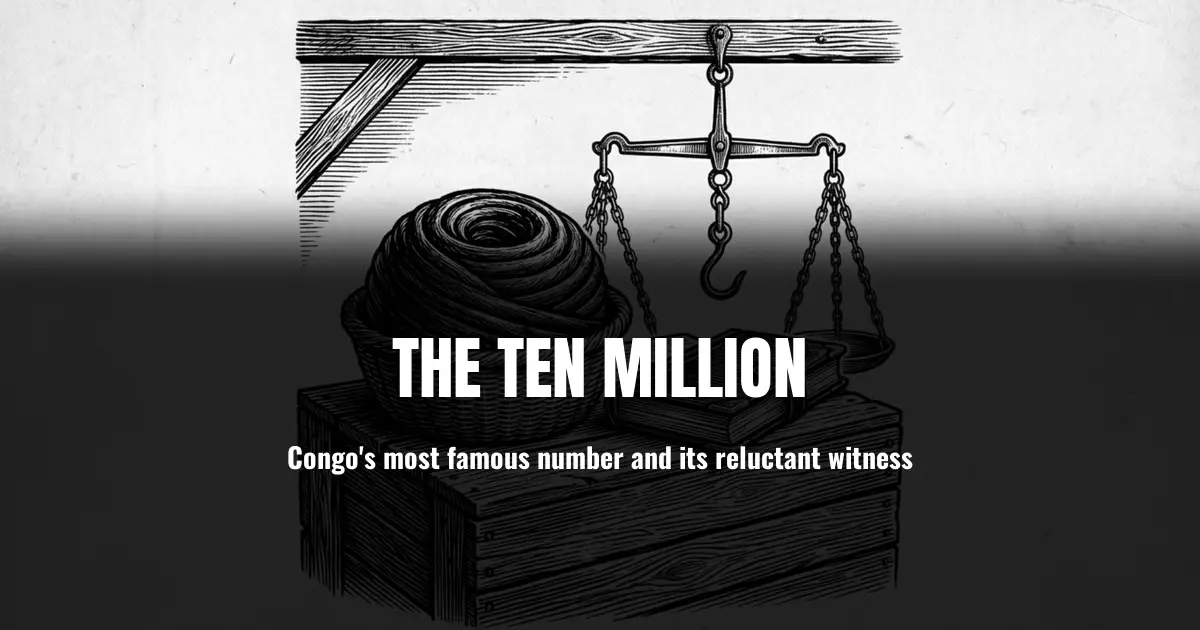
# The Ten Million: Congo’s Most Famous Number and Its Own Reluctant Witness
Ten million. It is the number attached to the Congo Free State the way six million is attached to the Holocaust, a figure that stands in for an atrocity too large and too badly documented to count directly. Adam Hochschild put it at the centre of King Leopold’s Ghost in 1998, a book that did more than any other to bring Leopold II’s personal colony back into public memory: roughly half the population, dead between 1880 and 1920, from murder, starvation, exhaustion, disease and a collapsing birth rate under a regime built on forced rubber extraction.
The number Hochschild used came from a specific scholar, Jan Vansina, the most respected historian of precolonial and colonial Central Africa working in English. In 2010, in a book most people citing the ten million have not read, Vansina said the estimate he was known for had misled people, including, in effect, himself.
What Casement’s own report actually said
The scandal that made the Congo Free State internationally notorious did not start with a death toll. Roger Casement, the British consul sent to investigate in 1903 and 1904, produced a report built on named testimony, village-by-village observation, and documented mutilations and hostage-takings under the rubber quota system. Its most quoted line on demographics is qualitative, not numerical: the population, Casement wrote, had diminished enormously. He supplied no colony-wide figure, because no colony-wide census existed for him to check against. Later writers summarising his report have disagreed about what number, if any, to attribute to him, some citing a Casement estimate of three million dead since 1888, others describing his report as implying up to ten million, a discrepancy that is itself a symptom of how loosely figures have circulated around this case from the very start.
The nearest thing to an official number came fifteen years later, not from Casement, but from a Belgian colonial administrator, Charles Lemaire, who estimated in 1919 that the population had fallen by half since the Free State’s founding. That 50 percent figure, not a body count, is the seed everything since has grown from.
How Hochschild got to ten million
Hochschild took the 50 percent decline and applied it to a pre-colonial population estimate of roughly 20 million, arriving at a loss of about 10 million. For the population figure and the demographic reasoning behind applying it, he relied on Vansina, whose scholarly reputation rested on decades of work reconstructing Central African history through oral tradition, linguistics and colonial archives, above all his detailed study of the Kuba kingdom in central Congo.
That regional depth was also the problem. Vansina’s population data came substantially from the Kuba region and other areas hit hardest by the rubber terror, the classic sites of documented atrocity that Casement and others had investigated because the abuses there were the most visible. Projecting a decline rate measured in the worst-affected rubber districts onto the entire territory of the Congo Free State, an area the size of Western Europe with regions the rubber companies barely touched, assumed a uniformity of suffering the underlying data never demonstrated.
Vansina’s 2010 retraction
In Being Colonized: The Kuba Experience in Rural Congo, 1880 to 1960, Vansina revisited his own earlier work and said plainly that he had been misled about the scale of population decline. He traced the error to flawed initial projections and to exactly the problem described above, the inappropriate extrapolation of local rubber-district data to the whole colony. His conclusion, in the absence of any reliable census before the 1920s, was that precise, colony-wide quantification of the death toll is not achievable. It remains, in his word, conjecture.
This is not a scholar quietly revising a footnote. It is the demographic authority behind history’s most quoted colonial death toll stating, in a book published twelve years after Hochschild’s, that the toll cannot be established at the level of precision everyone has been citing it with.
What the range actually looks like now
Once Vansina’s own caution is taken seriously, the ten million sits inside a much wider and much less settled range. The demographer Jean-Paul Sanderson, challenging Hochschild’s method directly, put the population decline at one to five million, arguing that the starting point of 20 million for 1885 is itself implausible when reconstructed by retroactive projection. The Congolese historian Isidore Ndaywel è Nziem estimated roughly 13 million in his 1998 history, published the same year as Hochschild’s book, then revised the figure downward in his 2008 revision. Jean Stengers, the historian most identified with careful Belgian colonial scholarship, is on record calling the ten-million figure absurd. None of this is fringe revisionism aimed at rehabilitating Leopold; Sanderson, Ndaywel and Vansina all accept that the Free State caused a demographic catastrophe. What they reject is the confidence with which one number has been repeated as if it were counted rather than reconstructed from thin and geographically skewed evidence.
What doesn’t add up
**The number’s own source called it misleading, and the correction rarely travels with the figure.** Vansina’s 2010 book is cited constantly alongside Hochschild’s 1998 book, as if the two texts simply agree, when Vansina’s later work is in substantial part a retraction of the method behind the number Hochschild popularized. Academic papers, museum text, journalism and Wikipedia itself routinely footnote „Vansina 2010“ next to the ten million figure without noting that Vansina 2010 is the document distancing him from it. What would fix this: any secondary source repeating the ten-million figure should be required to state, in the same sentence, that its own key source called the estimate a product of flawed extrapolation, not optional context but the load-bearing caveat.
**A rate measured in the worst-hit districts became a rate for a territory the size of Western Europe.** The Congo Free State covered roughly 2.3 million square kilometres; the documented atrocities, the severed hands, the hostage villages, the rubber quotas enforced by the Force Publique, are concentrated in the regions the concession companies actually worked, chiefly the equatorial rubber belt. Applying that region’s mortality to areas with little or no rubber concession activity, sparser colonial presence, and different disease and displacement dynamics is the exact move Vansina says misled him. What would settle it: the district-level demographic and administrative records that do survive from the Free State period, cross-checked against concession company boundaries, region by region, rather than one national percentage applied uniformly.
What stays open
None of this makes the Congo Free State less of an atrocity. The mutilations, the hostage-taking, the forced-labour deaths and the population collapse in the rubber districts are documented by contemporary witnesses, company records and Casement’s own fieldwork, independent of any national death toll. What is unsettled is the arithmetic that turned a documented regional catastrophe into a single, precise-sounding national figure repeated for a quarter century by people who, for the most part, have not read the page on which the figure’s own author walked it back.

KardiKassin
Writes about Africa’s colonial history and how it gets told, sourced and checked at every step.
Made in Germany: How Your Picture of Africa Was Manufactured
A rate measured in the worst-hit districts, stretched over a territory the size of Western Europe, until the number’s own source called it back. The free 12-page ebook traces that same kind of stretch across a whole continent’s worth of image-making.
Sources
- Hochschild, Adam: King Leopold’s Ghost: A Story of Greed, Terror, and Heroism in Colonial Africa. Boston: Houghton Mifflin, 1998
- Vansina, Jan: Being Colonized: The Kuba Experience in Rural Congo, 1880 to 1960. Madison: University of Wisconsin Press, 2010
- Casement, Roger: Correspondence and Report from His Majesty’s Consul at Boma Respecting the Administration of the Independent State of the Congo. London: His Majesty’s Stationery Office, 1904
- Wikipedia: King Leopold’s Ghost (for the Sanderson, Ndaywel and Stengers historiography and citations, cross-checked against the primary works named there). https://en.wikipedia.org/wiki/King_Leopold%27s_Ghost