A Wrong Sentence About a Man Who Was Already Dead
15. September 2026
Warum „Lügenpresse“ noch nie einer Seite gehört hat
16. September 2026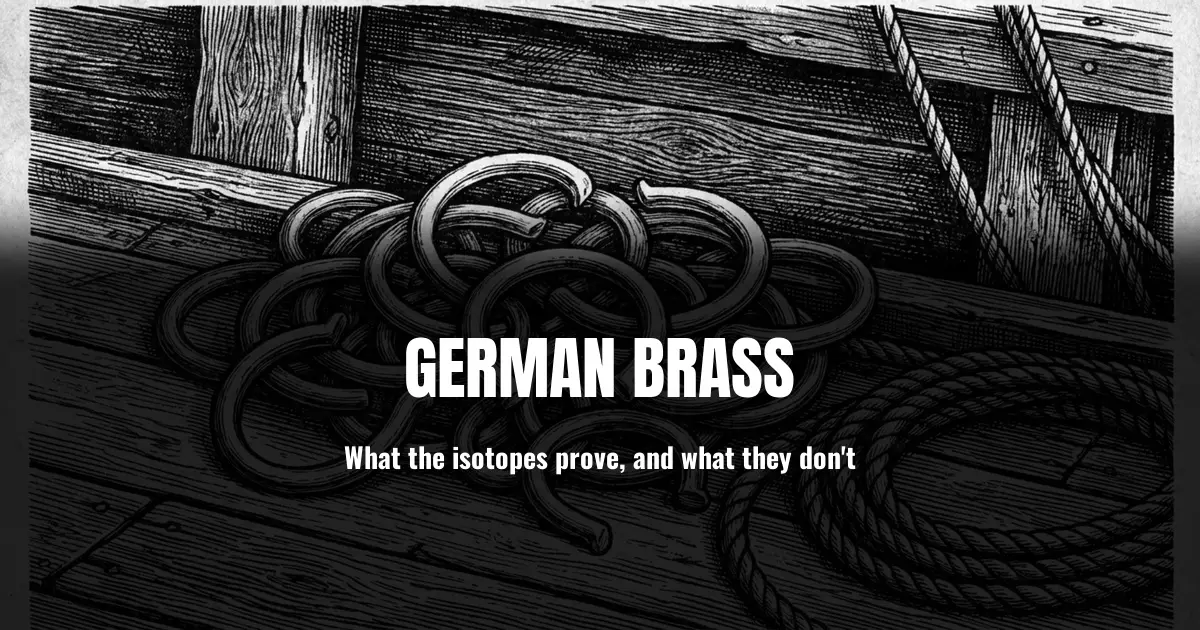
# German Brass in the Benin Bronzes: What the Isotopes Prove, and What They Don’t
In July 2022 Germany signed over ownership of more than 1,100 Benin Bronzes to Nigeria, the largest single restitution of looted African art so far. Nine months later, in April 2023, a study in PLOS One reported that the brass in those objects had been mined and smelted in the German Rhineland, between Cologne and Aachen, and shipped to West Africa as currency. The country returning the art had, four centuries earlier, supplied the metal.
That is the headline, and it travelled fast. The paper itself is more careful than the headline, and the gap between the two is where this gets interesting.
Rings that had no use in Europe
The metal arrived in West Africa in the form of manillas: open, horseshoe-shaped rings of brass or copper, cast in Europe for one purpose only, trade on the African coast. Nobody in Europe wore them or spent them. The paper’s authors (Skowronek et al., PLOS One 2023) make the point plainly: manillas had no function in European society. They were a product built to a customer’s specification, and the customer was African.
The specification was real. A contract from 1548 between the Fugger merchant family and the Portuguese crown, cited in the study, distinguishes two manilla types by destination: one for the „de la Mina“ trade on the coast of today’s Ghana, weighing 312 grams, one for the wider „Guine“ trade at 250 grams. The pieces were to match supplied models. African traders, according to the historical literature the study draws on, were exacting about which rings they accepted, and producers who ignored that lost the sale.
Documentary sources put the volume at hundreds of thousands of rings shipped from the late 15th century onward; the paper’s conclusion speaks of millions over the whole period. Neither figure comes with a ledger. The written record of this trade is thin, which is exactly why the authors turned to the metal itself.
Sixty-seven rings from five shipwrecks
Earlier attempts to link manillas to the Benin Bronzes had failed. The manillas available for testing were too impure to be plausible raw material, and none were securely dated to the period when the Bronzes were cast. A 1986 study by Craddock and Picton, quoted in the new paper, concluded there was no evidence the rings ever reached the Edo casters‘ crucibles.
Skowronek’s team changed the sample. They drilled 67 manillas from dated shipwrecks and excavated sites: a Flemish trader lost off Getaria, Spain, in 1524, chartered by Portuguese merchants and carrying 313 manillas; a mid-17th-century wreck off Elmina, Ghana, probably the Dutch West India Company ship Groeningen of 1647; the pirate ship Whydah Gally, sunk off Cape Cod in 1717; an English Channel wreck of the 1670s or 1680s; and the Douro, wrecked in the Scilly Isles in 1843 with three tons of manillas aboard. Add a ring from the Elmina town site in Ghana, four from a Swedish island, and one bought in a tourist market in Freetown, Sierra Leone.
Two measurements were made on each. Trace elements (antimony, arsenic, nickel, bismuth) point toward the copper source. Lead isotope ratios point toward the lead and zinc ore, and they do not change during smelting, so they act as a geological fingerprint.
The comparison material for the Bronzes came from earlier work: over 700 published chemical analyses (Riederer 2008) and a lead isotope study of 212 Benin objects (Willett and Sayre 2006). That older study had found something odd. 113 of the 212 objects fell into what its authors called an unusually small isotopic field. For art made over three centuries, with several European nations trading brass into the region, the metal looked as if it came from one place. Nobody could say which.
What the isotopes showed
The new data answers that. The early manillas, the „tacoais“ type traded by the Portuguese from Getaria, Elmina and Sierra Leone, sit in the same narrow isotopic field as the Bronzes. Both match the lead-zinc ores of the Rhineland. Ores from the Mendip Hills, Derbyshire and Upper Silesia do not. Because brass-making burned through roughly twice as much calamine as copper, smelters set up where the zinc ore was, so the isotope signature locates not only the ore but the workshop. The later manillas, British-made from the 18th century onward and typologically distinct, plot elsewhere and did not, on this evidence, end up in Benin’s casting pits.
The authors‘ conclusion, in their own words, is that the Rhineland was „the principal source“ of manillas at the opening of the Portuguese trade. I quote those three words because the whole debate since has turned on how far „principal“ reaches, and that is the subject of the section below.
Why it matters, and why some say it doesn’t
The finding was reported as a first, and it is: nobody had tied the Bronzes‘ raw material to a specific mining district before. But among people who work on Benin, a European origin for the metal was not news. Ndubuisi Ezeluomba, curator of African art at the Virginia Museum of Fine Arts, told Atlas Obscura in 2023 that a large share of the metal was always understood to have come from Europe, and that the Portuguese trade was the obvious place to start looking. He called the paper exciting and asked for more detail. He also asked, in effect, whether a Nigerian painter who buys canvas and pigment in Europe produces European art. His answer is no. The work belongs to whoever made it.
The restitution question
Barnaby Phillips, author of Loot: Britain and the Benin Bronzes, went further in the same piece: the metal’s origin is of little interest to the Edo themselves, and the more pressing historical question is a different one, namely how far manillas were being traded for enslaved people at all. On that, the historical evidence he cites points to Benin having fewer ties to the Atlantic slave trade than neighbouring coastal kingdoms. The kingdom was inland, and it had other things to sell: ivory, palm oil, cloth.
That question is not academic. In 2022 a US group, the Restitution Study Group, sued to block the Smithsonian’s transfer of Benin objects to Nigeria, arguing that the Bronzes were cast from manillas paid for enslaved people and therefore belong in part to their American descendants. A judge refused to stop the transfer. The argument, however, is now on the record, and the isotope study is being read into it from both sides. The German brass finding does not tell you what the brass was exchanged for. It tells you where the brass was dug up.
There is also the older Nigerian argument the paper touches only briefly. Casting in the region predates the Portuguese by centuries: the Igbo-Ukwu bronzes of the 9th and 10th centuries, cited in the study, were made from a metal with a different chemistry entirely, long before any Atlantic ship arrived. The Ife tradition to the north-west is likewise pre-contact. Between Ife and Benin there is a long-running dispute over which came first and who taught whom, and the manilla data has nothing to say about it. What the manillas changed was volume. On this point the scientists, the historians and the curators agree: European brass did not create the casting tradition, it flooded it with material.
What doesn’t add up
The claim reaches further than the sample
The conclusion says the Rhineland manillas were likely the major, „virtually the only,“ source of brass for West African casters for three centuries, including the Benin Bronzes. The lead isotopes support that. Trace elements do not, or not as cleanly. Antimony, arsenic, nickel and bismuth vary far more across the Bronzes than within any manilla group, and many Bronzes contain more tin than any manilla does. The authors say so themselves and offer the obvious explanation: the casters were mixing manillas with older scrap, possibly bronze, and the heavy lead load of the manillas overprinted whatever isotope signal that scrap carried. That is a plausible reading. It is also an admission that the method cannot see the other ingredients.
So the sentence „made of German brass“ is true for the lead in the alloy and unproven for the rest. What would settle it: analysis of the other Rhenish trade goods that went to the same coast, the brass rods and basins the paper mentions but did not test, and a direct sampling programme on the Bronzes themselves rather than a reliance on data published in 2006 and 2008.
A trade figure without a floor
„Hundreds of thousands“ of manillas in the introduction becomes „millions“ in the conclusion, and neither number is sourced to a count. The 1548 Fugger contract gives weights and types, not quantities delivered. Denk’s 2020 typology, on which the whole tacoais-versus-Birmingham distinction rests, is a private research project, cited but not independently reviewed in the paper. None of this makes the isotope match wrong; the geochemistry stands on its own. But every popular retelling has quietly adopted the larger number, and the larger number is the one doing the moral work in the restitution argument. Antwerp notarial records and Portuguese crown accounts for the Mina trade would put a floor under it. The paper cites the archive series but does not extract the figures.
What stays open
The return itself has moved on since the study appeared, and not smoothly. In March 2023 Nigeria’s outgoing president declared the Oba of Benin the owner of all repatriated objects, which stalled further transfers from Saxony and set off a row in the Bundestag about whether restitution can carry conditions. The purpose-built Museum of West African Art in Benin City, once meant to house the returns, opened in late 2025 focused on contemporary art after the palace objected, and is now the subject of a court case and a state assembly inquiry. Around 150 objects have physically come back. As of this year, none of the German returns are on public display in Nigeria.
So the material sits where it always did: in the middle. Dug in the Rhineland, cast in Benin, looted by Britain in 1897, catalogued in Berlin, and now legally Nigerian while physically, for the most part, still in Europe on loan. The isotopes settle the first stop on that route. Every other stop is still being argued.

KardiKassin
Writes about Africa’s colonial history and how it gets told, sourced and checked at every step.
Made in Germany: How Your Picture of Africa Was Manufactured
The brass in this story was manufactured in Germany and shipped south for a purpose someone else decided. The free 12-page ebook runs the same checking over a whole continent’s worth of image-making.
Sources
- Skowronek, T. B., DeCorse, C. R., Denk, R. et al.: German brass for Benin Bronzes: Geochemical analysis insights into the early Atlantic trade. PLOS One 18(4), 2023. https://doi.org/10.1371/journal.pone.0283415
- Willett, F. and Sayre, E. V.: Lead isotopes in West African copper alloys. Journal of African Archaeology 4, 2006 (cited via Skowronek et al.)
- Craddock, P. T. and Picton, J.: Medieval copper alloy production and West African bronze analyses, Part II. Archaeometry 28, 1986 (cited via Skowronek et al.)
- Denk, R.: The West African Manilla Currency. Research and Securing of Evidence from 1439 to 2020. Rüsselsheim 2020 (cited via Skowronek et al.)
- Tarlach, G.: Are the Benin Bronzes Made From German Brass, and Does It Matter? Atlas Obscura, 5 April 2023 (updated 2025). https://www.atlasobscura.com/articles/benin-bronze-origins
- Archaeology Magazine: The Benin Bronzes‘ Secret Ingredient. November/December 2023. https://archaeology.org/issues/november-december-2023/digs-discoveries/the-benin-bronzes-secret-ingredient/