Das Rad in Westafrika: Bekannt, aber jahrhundertelang liegen gelassen
30. Oktober 2026
Warum eine lückenlose Geschichte oft nur eine bequeme ist
31. Oktober 2026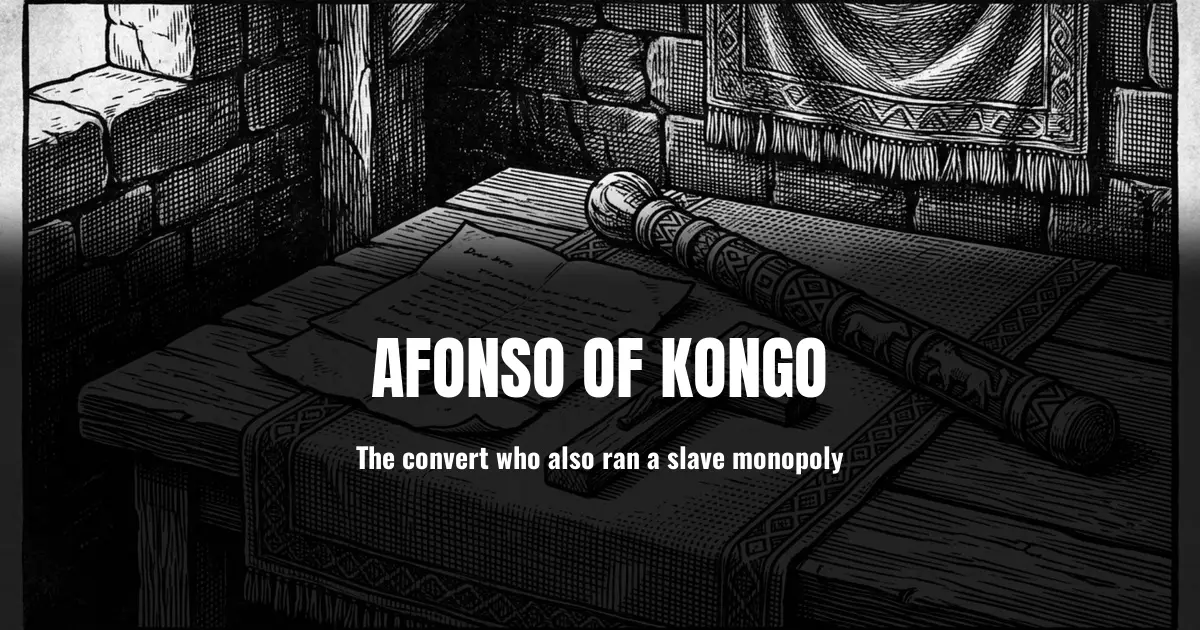
# Afonso of Kongo: The Convert Who Also Ran a Slave Monopoly
Afonso I of Kongo is usually introduced as a success story of early African Christianity: baptised in 1491 as a young prince, tutored for a decade by Portuguese priests, victorious in a succession war that Kongo tradition credits to the intervention of Saint James, and king from 1506 or 1509 until his death in 1542 or 1543. Textbooks add a second layer to the story, his 1526 letters to King João III of Portugal, in which he protests that Portuguese traders were kidnapping his own nobles and relatives to sell as slaves. Put those two facts side by side, an eager convert and a ruler who denounced the slave trade, and the usual conclusion is a simple one: a good king corrupted by a bad trade, or a European crown that baptised with one hand and enslaved with the other.
Afonso’s own correspondence does not support the simple version. He was not opposed to the slave trade. He had signed onto it.
What the 1526 letters actually say
The letters survive, at least in part, and the passage most often quoted is specific about who was being taken and how. Writing to João III, Afonso describes free subjects being seized by traders eager to profit from Kongolese demand for Portuguese goods, and states that noblemen, the sons of noblemen, and his own relatives were among those taken, hidden or moved under cover of night so they would not be recognised and reclaimed. He adds a second, connected complaint: the sheer volume of Portuguese merchandise reaching his vassals directly had made them less obedient to the crown, since they no longer needed to go through him to get what they wanted. The two complaints belong together. Afonso is not describing an abstract moral catastrophe. He is describing a breakdown of his own authority, people he considered his subjects, relatives among them, being taken outside his control by traders who were also undermining his monopoly on distributing European goods.
The monopoly he had already agreed to
That control had a specific origin. In 1512, fourteen years before the famous letters, Afonso and King Manuel of Portugal struck an agreement, described by the historian John Thornton, to share a monopoly on slaves bound for the sugar plantations of São Tomé: the Portuguese crown would buy slaves only through Kongo, and Kongo would supply them, mostly captives taken in wars against neighbouring peoples outside the kingdom’s core territory. This was not a arrangement Afonso stumbled into. It was a deal he made, and by most accounts one that suited him, since it gave the Kongo monarchy a steady channel for European firearms, cloth and manufactured goods in exchange for a commodity, war captives, that Kongo’s own campaigns kept supplying.
What went wrong, in Afonso’s telling, was not the trade itself but its escape from his control. Portuguese settlers on São Tomé, cut out of the direct profits by the crown’s monopoly, began buying captives from sources Afonso did not manage, first from areas south of Kongo along the Kwanza River, and, according to at least some readings of the 1526 letters, from within Kongo’s own core territory as well. Historians disagree, Thornton notes, on exactly which Afonso meant: some read the letters as describing kidnapping deep inside Kongo’s heartland, which would mean the kingdom’s own institutions were failing to protect its people; others read them as describing the contested frontier zones, which would be a threat to Kongo’s expansion rather than to its core. Either reading describes the same underlying problem from the king’s chair: traders operating outside the channel he had negotiated, taking people, in some cases his own relatives, and selling them without his sanction or his cut.
Afonso’s response in 1526 was not to renounce the institution of slavery. He issued decrees to regulate it, according to the Dictionary of African Christian Biography, and set up a commission meant to certify that no one was taken by kidnapping rather than through lawful channels, war captivity chief among them. The commission did not hold. Portuguese traders, missionaries included, kept pushing inland for captives, and by the 1530s the slave markets on São Tomé had contacts reaching well past anything Afonso’s commission could inspect.
Two flattened stories
The textbook version of Afonso, the eager convert who built a cathedral and sent his son to be consecrated a bishop in Rome, is accurate as far as it goes and leaves out that his Christian kingship was financed in large part by the same slave trade his most quoted letter complains about. The corrective version, popular online, treats the 1526 letters as proof that African kings did not sell their own people and that the trade was a purely European imposition; that version leaves out the 1512 monopoly, Afonso’s own decrees regulating rather than abolishing the practice, and the fact that his kingdom’s wars against its neighbours were themselves the source of the captives he was contracted to supply.
Both flattened stories serve a clean narrative. Neither survives contact with the letters and the agreement that came before them.
What doesn’t add up
**A protest letter is being read as an abolition and it was neither.** Afonso’s 1526 complaint is aimed at unauthorised, unregulated slaving that bypassed his monopoly and reached his own nobility, not at the trade as an institution he had personally signed onto in 1512. The line most often quoted, that the kingdom should have only priests and no merchandise but wine and flour for Mass, is rhetorical, addressed to a specific grievance about Portuguese goods flooding his market, not a demand to end the slave trade Kongo itself was running through lawful channels. What would settle exactly how far his objection went: a full critical edition of all twenty-four surviving letters, not just the most-quoted excerpts, cross-read against the 1512 agreement’s actual terms, which the 2023 Thornton and Madureira biography of Afonso is the first English-language attempt to provide.
**Whether the kidnapping happened in Kongo’s heartland or its frontier changes what the letters mean, and this is unresolved.** If Portuguese traders were taking people from within Kongo’s settled core, the letters describe a king whose own state could not protect its citizens. If the traders were operating in the contested Kwanza River zone Kongo was still trying to absorb, the letters describe a frontier dispute over resources, not a domestic crisis. Thornton states plainly that historians read the same passages both ways. What would settle it: a geographic reconstruction of the place-names and raiding routes named in the letters, matched against what is independently known of Kongo’s administrative reach in the 1520s.
What stays open
Whether Afonso, given the chance, would have ended the slave trade rather than merely regulated it back under his own control is not something the letters answer, because he was never given that chance to demonstrate one way or the other; the trade outlived him, outlived Kongo’s independence, and by the seventeenth century had turned inward on the kingdom itself, with Kongolese civil wars supplying captives to the same Atlantic system Afonso had once tried to manage from the top.

KardiKassin
Writes about Africa’s history and how it gets told, sourced and checked at every step.
Made in Germany: How Your Picture of Africa Was Manufactured
One quoted letter, read as an abolition it never was, flattened into two clean stories that both leave something out. The free 12-page ebook traces that same kind of flattening across a whole continent’s worth of image-making.
Sources
- World History Commons: Excerpt of Letter from Nzinga Mbemba to Portuguese King João III (1526), with English translation of the original Portuguese. https://worldhistorycommons.org/excerpt-letter-nzinga-mbemba-portuguese-king-joao-iii
- Thornton, John K.: Afonso and the Slave Trade. Gilder Lehrman Institute, AP African American Studies curriculum unit, 2025 (the 1512 monopoly agreement with Manuel of Portugal, and the historiographical dispute over where in Kongo the 1526 kidnappings took place). https://www.gilderlehrman.org/ap-african-american-studies/unit-1/southern-central-and-east-africa/alfonso-slave-trade-2025
- Dictionary of African Christian Biography: Afonso I. https://dacb.org/stories/congo/afonso1/ (the 1526 regulatory decrees and the commission against kidnapping)
- Thornton, John K. and Luís Madureira: Afonso I Mvemba a Nzinga, King of Kongo. 2023 (new English translation and critical edition of Afonso’s correspondence)